Balloons TD Replica
Project Overview
I built a full tower defense game in Python using Pygame that replicated the core design and mechanics of the classic Bloons TD series. I recreated the complete set of game elements, including towers, projectiles, path-following balloons, collision detection, and wave progression, and implemented all sprite interactions so that each tower and balloon behaves as expected.
The result was a fully interactive, playable game with upgradeable towers, multiple rounds of increasing difficulty, and a responsive UI built entirely with custom code. This project demonstrated my ability to translate a complex existing game design into code from scratch, handle real-time event loops, sprite management, and collision logic, and produce a polished interactive experience in Python.
Game Screenshots
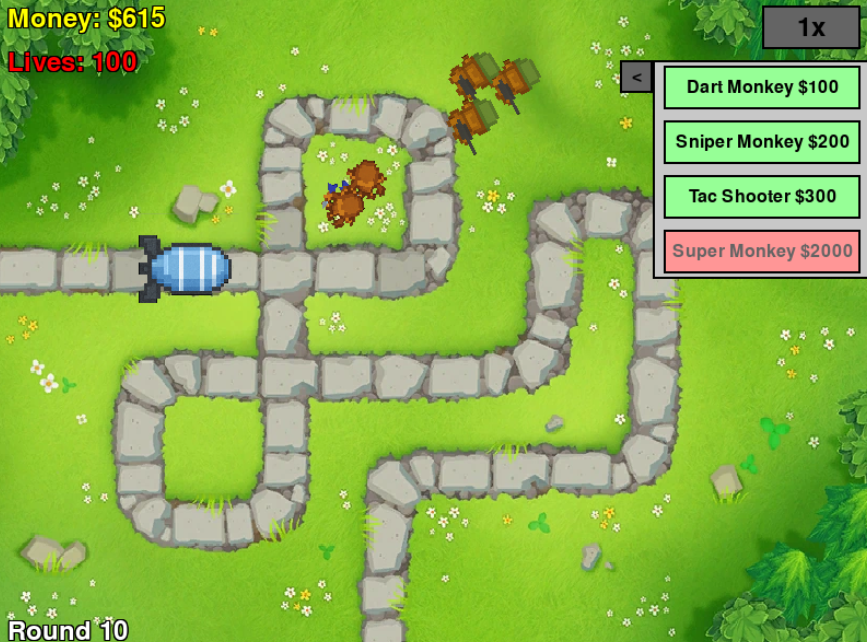
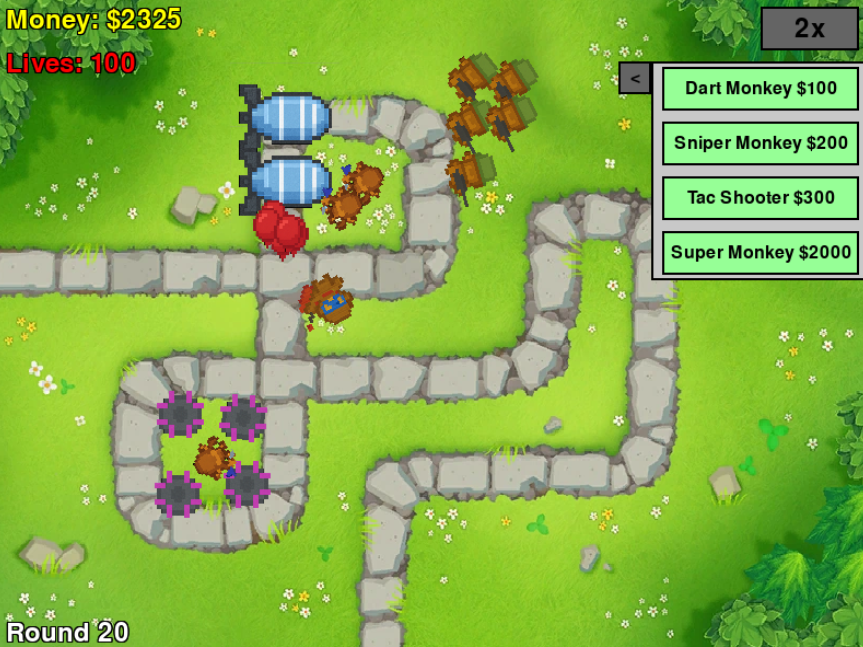
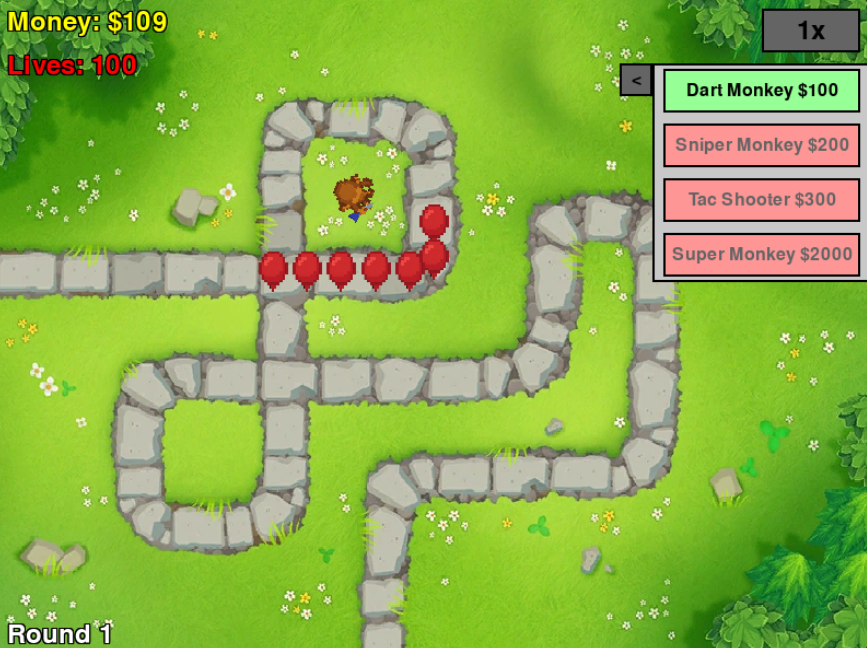
The Challenge
Recreating a complex game like Bloons TD requires implementing multiple interconnected systems: pathfinding, collision detection, tower targeting, upgrade systems, and wave management. Each system must work seamlessly together while maintaining smooth performance.
The Solution
Designed a modular architecture with separate classes for towers, balloons, projectiles, and game state. Used object-oriented programming principles to create reusable components and implemented efficient collision detection algorithms to maintain 60 FPS gameplay.
Technical Implementation
Core Systems
- Real-time game loop
- Sprite management system
- Collision detection engine
- State management
Game Mechanics
- Tower placement and upgrades
- Path-following AI for balloons
- Projectile physics
- Wave progression system
Features
- Multiple tower types
- Upgrade system
- Currency management
- Difficulty scaling
Technologies
- Python 3.8+
- Pygame library
- Object-oriented design
- Custom sprite animations
Development Process
The development process began with analyzing the original Bloons TD game to understand its core mechanics and game feel. I then designed a class hierarchy that would support extensibility, allowing for easy addition of new tower types and balloon variants.
I implemented the game in phases: first the basic game loop and rendering, then balloon pathfinding, tower placement, projectile systems, and finally the upgrade and economy systems. Each phase included extensive testing to ensure smooth gameplay and bug-free interactions.
Performance optimization was crucial - I used spatial partitioning for collision detection and implemented object pooling to reduce memory allocation overhead during intense gameplay moments with hundreds of balloons and projectiles on screen.
Key Learnings
This project significantly improved my understanding of game development fundamentals, including game loops, event handling, and performance optimization. I learned the importance of clean architecture in complex interactive systems and how to balance code reusability with performance.
Working with Pygame taught me valuable lessons about graphics rendering, sprite management, and creating smooth animations. The experience also enhanced my debugging skills, as tracking down issues in real-time systems requires different approaches than traditional software debugging.
Source Code
The complete source code for this project is available on GitHub. The repository includes all game logic, sprite management systems, and documentation for running the game.